What We Have

“Being with him when he died was something I will never forget. His bravery. His happiness. His acceptance. It was a colossal experience for me. Changed my life completely in a way that I had not expected. I expected to feel sad and lost. But I felt the opposite. Just, like, ‘Boy, this is it. This is all we have. Right here. So you’d better pay attention.’”

Laurie Anderson and Lou Reed
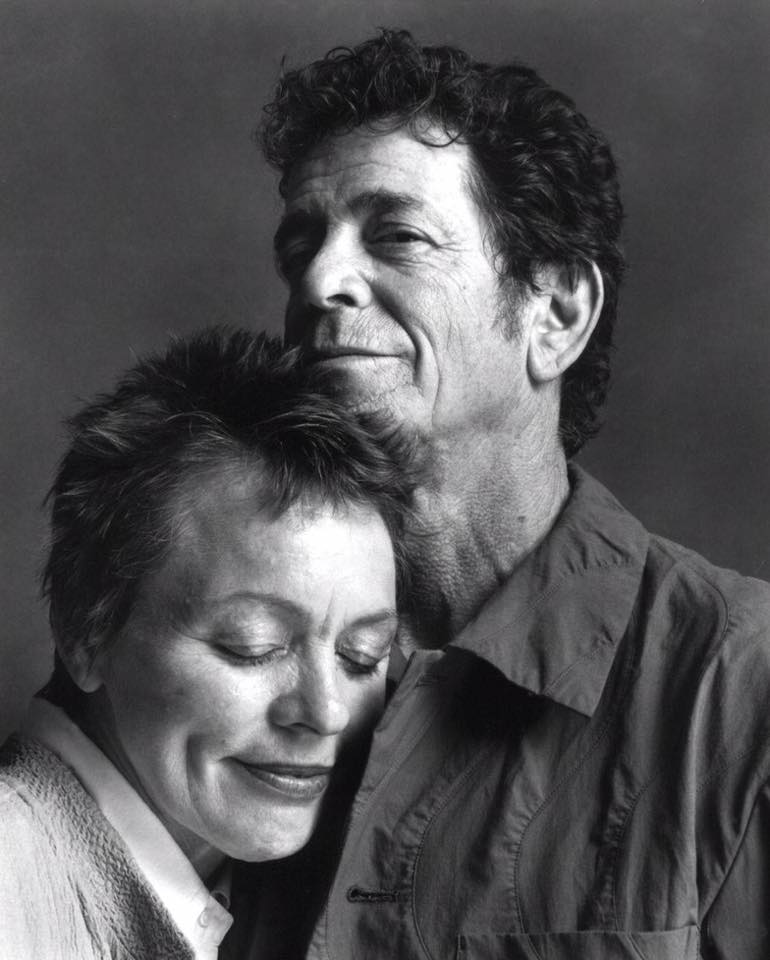
This certainly set off a firestorm of controversy. Not the photo but the words by Anderson. Predictable things: How can she say that?! Of course there’s more than now…Heavenly, etc., Still miss my wife and I loved her for many more years than…Who is she kidding? No grief and loss? Angry rhetoric that somehow people thought was appropriate rather than trying to understand. I find those sorts of things amazing. It’s never a matter of seeking what she came to experience, but rather a diatribe about a belief system—one’s own. Oi!

Of course there were also many who believed they understood what she had to say, with or without a Heaven to come. All of a measure of one’s own life, and death.

So, she wrote of how they came to be, how their minds entangled and how they could imagine no others than each other.

How when it came time for him to die to this earth he was in ecstatic conversation with The Other, communicating in Tai Chi symbols, his hands dashing madly about in front of him, a Light that grew and emanated, and a smiling countenance that made his face seem on fire.

This gave me chills of light, of joy. A death to Celebrate, as some are.

Schopenhauer

Schopenhauer left us on this date in 1860. (February 22, 1788–September 21, 1860) His major work The World as Will and Representation gave us an understanding of the differences and relationship between Art and Science. Schopenhauer uses mutability as the criterion of distinction — science, he argues, is concerned with change, whereas art contemplates the eternal. Mutability as the tendency to change while the Eternal is the Always. The 1818 masterwork also gave us Schopenhauer on the relationship between genius and madness, and the crucial difference between genius and talent.

This according to Maria Popova, who can be read or followed on https://www.brainpickings.org.

Thinking-Thought-Mind

This is an excerpt from the 7th Public Talk given by J. Krishnamurti in Saanen, 1972.

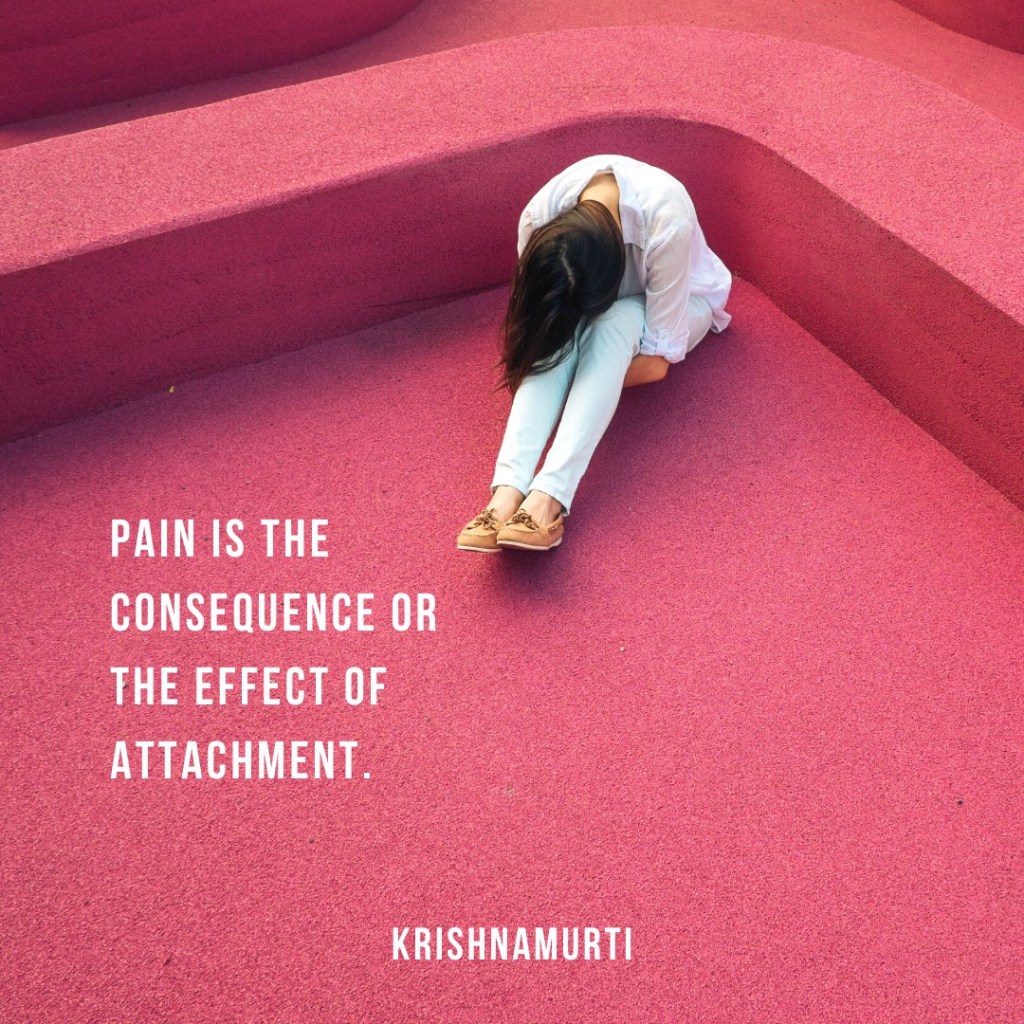
“So the mind, which is absolutely quiet, has space without any object in it. The moment there is an object, that object creates space around itself, and therefore there is no space. You understand this? When there is, in one’s mind, an object, a belief, fear, the persistent demand for pleasure – objects – then each object creates its own little space round itself. And we try to expand these little spaces, hoping to capture the great space. So the mind that is completely quiet has space in which there is no object, and therefore an attention, not about something, or attention towards something, simply a state of attention. And if you notice, when there is attention there is extraordinary space. It is only when there is no attention the object becomes important. So attention is not a matter of cultivation, going to a school to learn how to be attentive, going to Japan or India or some Himalayan town and learn to be attentive, which is all so manifestly silly, but attention is this extraordinary sense of space. And that cannot exist when the mind is not completely quiet. And this quietness is total harmony.Then the mind is not dissipating energy. Now we dissipate energy – in quarrels, in gossip, in fighting each other – you follow? – oh, in dozens of ways. And we need tremendous energy to transform ‘what is’ – ‘what is’, is my anger, your anger, your ambition, your greed, your envy, the desire for power, position, prestige – the ‘what is’. To go beyond ‘what is’, you need tremendous energy. But you have no energy if you are battling with ‘what is’.So life is a movement in harmony when there is this energy that has gone beyond ‘what is’. Because attention is the concentration of total energy. And all this is meditation. And one asks: is there something beyond all thought, something which is not measurable, not nameable, that no words can describe – is there something like that? How are you going to find out?” J.Krishnamurti Saanen, 1972

Carl Jung on Synchronicity

The following was posted by Psyche’s Call with Donna May on Facebook. I’ve used the entire quote and without edit. Any copyedit errors belong to the origin, not to me. (Thank you ever so much.) Obviously adding to our other posts on the same subject.
 
 
[Sadly “Synchronicity” is all too often tossed about describing events which do not adhere to the actual meaning of synchronistic events as used within Depth Psychology.]
Synchronicity:
A phenomenon where an event in the outside world coincides meaningfully with a psychological state of mind.
Synchronicity . . . consists of two factors: a) An unconscious image comes into consciousness either directly (i.e., literally) or indirectly (symbolized or suggested) in the form of a dream, idea, or premonition. b) An objective situation coincides with this content. The one is as puzzling as the other.[“Synchronicity: An Acausal Connecting Principle,” ibid., par. 858.]
Jung associated synchronistic experiences with the relativity of space and time and a degree of unconsciousness.
The very diverse and confusing aspects of these phenomena are, so far as I can see at present, completely explicable on the assumption of a psychically relative space-time continuum. As soon as a psychic content crosses the threshold of consciousness, the synchronistic marginal phenomena disappear, time and space resume their accustomed sway, and consciousness is once more isolated in its subjectivity. . . . Conversely, synchronistic phenomena can be evoked by putting the subject into an unconscious state.[“On the Nature of the Psyche,” CW 8, par. 440.]
Synchronicity was defined by Jung as an “acausal connecting principle,” an essentially mysterious connection between the personal psyche and the material world, based on the fact that at bottom they are only different forms of energy.
It is not only possible but fairly probable, even, that psyche and matter are two different aspects of one and the same thing. The synchronicity phenomena point, it seems to me, in this direction, for they show that the nonpsychic can behave like the psychic, and vice versa, without there being any causal connection between them.[Ibid., par. 418.]


david-moynahan

In a vain attempt to recover the original posted photo I’ve rather messed things up. Somewhat. (The details are irrelevant.) In the end the original was unrecoverable so now we have the above. I don’t know why this seems relevant but it does. So in the spirit of Jung’s unconscious-studies, I’ve stayed the course.

At first glance I thought this was Ophelia floating face down in a pond. Upon second glance I thought no, it’s something transparent floating there. Then I happed upon the thought of a rock, as solid as anything possible and yet translucent. Or not.

And that’s the way things are.

Football! Happy Days Here Again!

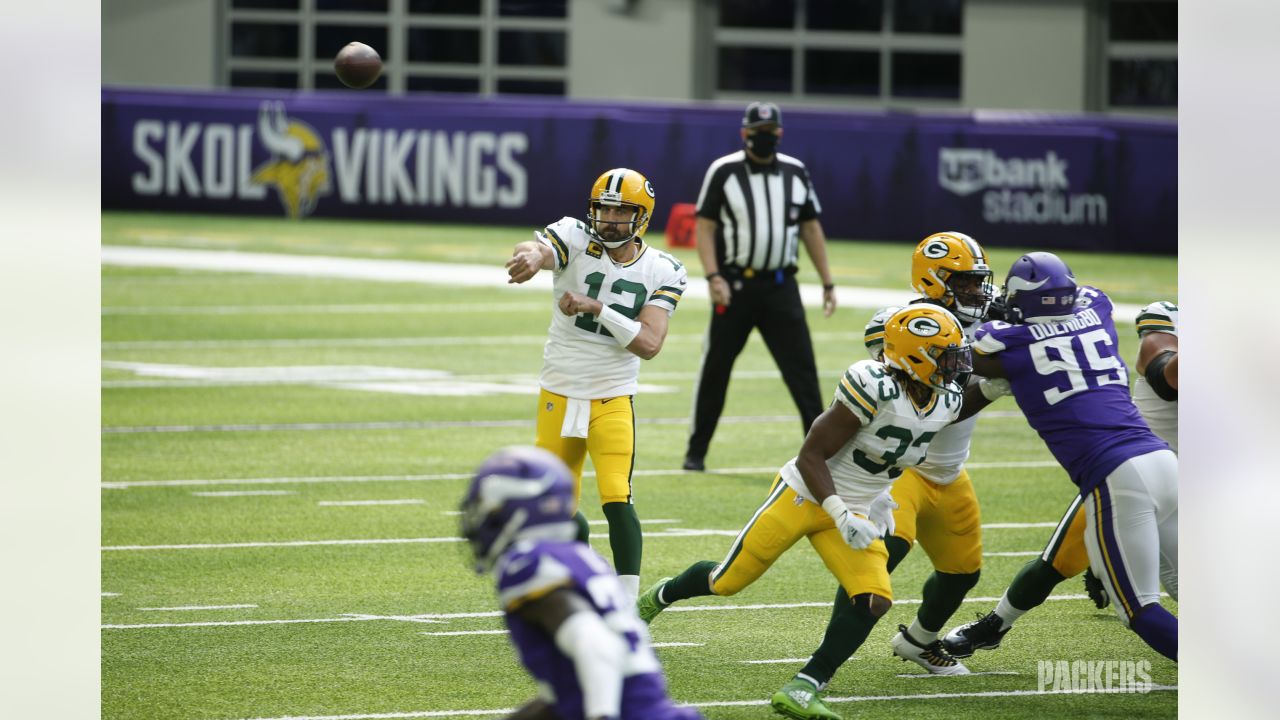
Making it perfect! Packers’ offense shines in 43-34 win over Vikings in opener

200913-game-WM-010

200913-game-WM-006

Photos taken by Bruce Kluckhohn, AP— for Packers

What a beautiful game. It looks like we’ll be able to make it through this season of Covid 19 with a Season to Match—Football! Need I say I am ever so happy?

The GOAT has reared up, snorted, and given a marvelous head-butt.

(For those who don’t know, GOAT stands for Greatest of all time, aka, Aaron Rodgers, QB.)