Integrated highlights from an article in Quartzy By Annaliese Griffin
The original Greek myth of Medusa offers plenty to be angry about. The monstrous being with snakes for hair starts out as a human woman, who Poseidon rapes in Athena’s temple. The goddess then punishes Medusa by turning her into a Gorgon and exiling her. Perseus is later sent on an errand to bring Medusa’s head to King Polydectes. Equipped with a mirrored shield, winged sandals, and a special sack for her head, Perseus creeps up on Medusa while she lies sleeping, cuts off her head, and then uses it as a weapon for turning enemies into stone.
Poseidon rapes, and the victim, Medusa, is punished by another woman. The Scene, the Myth, the Archetype, was set a long time ago and is the foundation via Greek and Western Culture—for the lives we play out today. Not just the woman as victim, but the slayer as man supported by other women.
A sculptor, Luciano Garbati, decided it was time for a change.
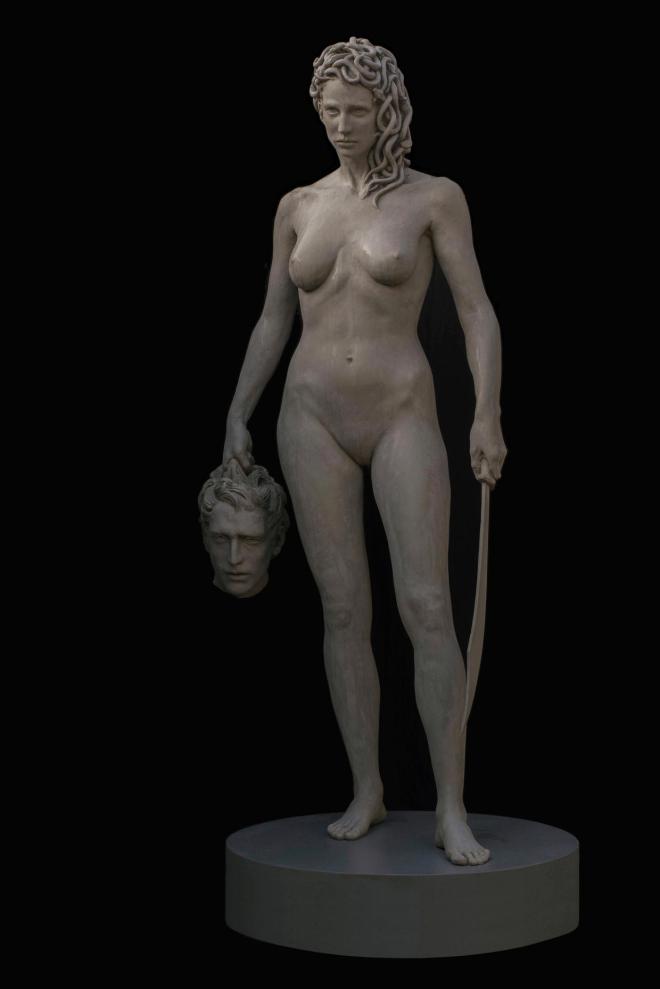
“Medusa” by Luciano Garbati
Garbati came to question the characterization of Medusa as a monster, pointing out that she was “raped and cursed and killed.” As an artist, he became fascinated with one question: “What would it look like, her victory, not his? How should that sculpture look?”
Before the attention on social media, Garbati’s Medusa had been lingering in relative obscurity. Though he sculpted her in clay, then cast her in resin with fiberglass reinforcement a decade ago, the work has only been in one show, and remains in his studio in Buenos Aires, available for sale in the original resin for $35,000, or in bronze for approximately $25,000 more, depending on the foundry. Standing at more than two meters tall, she’s larger than life, even more outsized than her social media presence.
“This difference between a masculine victory and a feminine one, that was central to my work. The representations of Perseus, he’s always showing the fact that he won, showing the head…if you look at my Medusas…she is determined, she had to do what she did because she was defending herself. It’s quite a tragic moment.”
Garbati posted photos of the sculpture to his Facebook page earlier this year. He immediately noticed friends, then friends of friends, and then people he didn’t know at all, using the image to illustrate their reactions to the news, or as a profile photo. An Italian writer named Sara Giovinazzi published a blog post that used his sculpture to reflect on the idea of mythological inversions spread the image even further.
When Medusa started popping up all over social media, on Reddit, Twitter, and Instagram, Garbati joined Twitter to gently remind fans that he was the artist behind the work, and that the sculpture was not, as some had reported, in Florence, Italy, but in his studio in Argentina. Garbati says he has appreciated finding a new audience for an older work, but what was really gratifying and striking to him were the messages about Medusa and his version of the story.
If I had $35,000, I would have a statue of Medusa in my living room.


 Writers Ink—Writing and Stuff