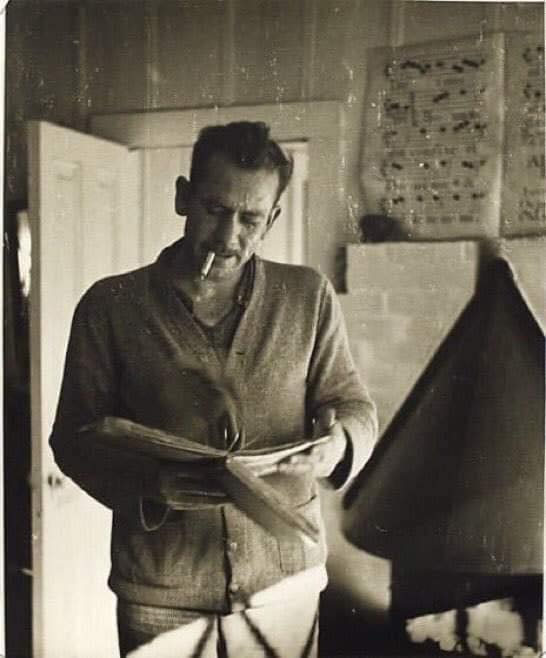
Believe it or not, on the the actual day of birth I’ve made this post of our dear friend John Steinbeck.
Posted by Poetic Outlaws
“To be alive at all is to have scars.” – John Steinbeck, born on this day in 1902. That is one year before me mum was born.
There seems to be somewhat of a renaissance of Steinbeck’s work, his novels, East of Eden and Grapes of Wrath both making best-books lists this year. Of course Of Mice and Men always makes it on a list of the best.
I remember reading the book when I was a teenager. I also remember coming to the part in the novel where someone put vaseline on his hand and wears a glove over it. I asked Mother what that meant. Well, she said, it’s not very nice. OK then. Thanks for the help, Mom. And that, in a nutshell, is the extent of my sex education.
“Blessed is the man who, having nothing to say, abstains from giving us wordy evidence of the fact.
“George Eliot, orig. Mary Ann Evans later Marian Evans, (born Nov. 22, 1819, Chilvers Coton, Warwickshire, Eng.—died Dec. 22, 1880, London), British novelist. Eliot was raised with a strong evangelical piety but broke with religious orthodoxy in her 20s. She worked as a translator, a critic, and a subeditor of the Westminster Review (1851–54). Later she turned to fiction. Adopting a masculine pseudonym to evade prejudice against women novelists, she first brought out Scenes of Clerical Life (1858). This was followed by such classic works as Adam Bede (1859), The Mill on the Floss (1860), Silas Marner (1861), Romola (1862–63), Felix Holt, the Radical (1866), and Daniel Deronda (1876). Her masterpiece, Middlemarch (1871–72), provides a thorough study of every class of provincial society. The method of psychological analysis she developed would become characteristic of modern fiction. With the journalist, philosopher, and critic George Henry Lewes (1817–78), a married man, she enjoyed a long and happy, though scandalous, liaison; their Sunday-afternoon salons were a brilliant feature of Victorian life.”
Impressions of Theophrastus Such/Chapter IV chapter 4 (1879)
Posted by AsAboveSoBelow.
They still taught her books when I was in highschool. And about her name, or the changing of it anyway. I always thought my true name was George and would have changed it to that were it not for both my brother and father named George. I felt rather cheated. It’s not too late now and I could embrace that much easier than as a child, but it would be worse than changing your phone number. Just consider the number of contacts involved. To say nothing of the explanations.
The subject of “Naming Things” itself would be several posts. There’s the biblical “As a man is called, so is he.” Or something like that. And children! The children who want to change their names. Do they all? Do they still? My brother wanted to be called Jim. Just because he liked it. Were I his mother I would have called him Jim. Not a sight or sound for my mother of course.
And this is, too, The Way Things Are. At least for today.


 Writers Ink—Writing and Stuff