…a little better than yesterday

Posted by Bob Blair
This morning at Botzum Barn in the Cuyahoga Valley. So we know there will be mornings like this.

…a little better than yesterday
Posted by Bob Blair
This morning at Botzum Barn in the Cuyahoga Valley. So we know there will be mornings like this.
Well, here’s our fellow. And all most of us know him from is the “I think, therefore I am.” Cogito ergo sum That and the claim that Sylvester Stallone is a look-alike. (The eyes, right?)
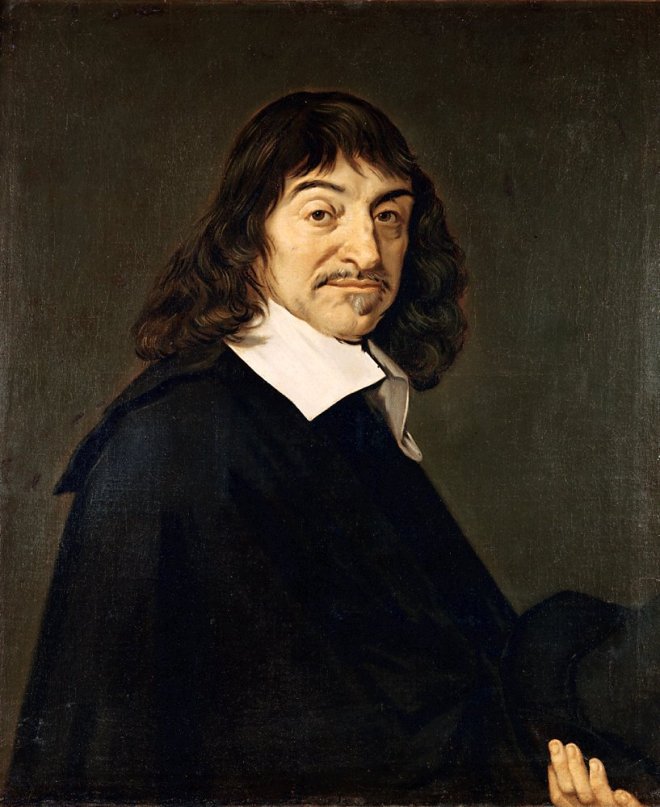
Portrait of Descartes after Frans Hals, 1648
As posted in Brain Pickings. His twelve-vertebrae backbone of critical thinking reads as follows:
- The aim of our studies must be the direction of our mind so that it may form solid and true judgments on whatever matters arise.
- We must occupy ourselves only with those objects that our intellectual powers appear competent to know certainly and indubitably.
- As regards any subject we propose to investigate, we must inquire not what other people have thought, or what we ourselves conjecture, but what we can clearly and manifestly perceive by intuition or deduce with certainty. For there is no other way of acquiring knowledge.
- There is need of a method for finding out the truth.
- Method consists entirely in the order and disposition of the objects towards which our mental vision must be directed if we would find out any truth. We shall comply with it exactly if we reduce involved and obscure propositions step by step to those that are simpler, and then starting with the intuitive apprehension of all those that are absolutely simple, attempt to ascend to the knowledge of all others by precisely similar steps.
- In order to separate out what is quite simple from what is complex, and to arrange these matters methodically, we ought, in the case of every series in which we have deduced certain facts the one from the other, to notice which fact is simple, and to mark the interval, greater, less, or equal, which separates all the others from this.
- If we wish our science to be complete, those matters which promote the end we have in view must one and all be scrutinized by a movement of thought which is continuous and nowhere interrupted; they must also be included in an enumeration which is both adequate and methodical.
- If in the matters to be examined we come to a step in the series of which our understanding is not sufficiently well able to have an intuitive cognition, we must stop short there. We must make no attempt to examine what follows; thus we shall spare ourselves superfluous labour.
- We ought to give the whole of our attention to the most insignificant and most easily mastered facts, and remain a long time in contemplation of them until we are accustomed to behold the truth clearly and distinctly.
- In order that it may acquire sagacity the mind should be exercised in pursuing just those inquiries of which the solution has already been found by others; and it ought to traverse in a systematic way even the most trifling of men’s inventions though those ought to be preferred in which order is explained or implied.
- If, after we have recognized intuitively a number of simple truths, we wish to draw any inference from them, it is useful to run them over in a continuous and uninterrupted act of thought, to reflect upon their relations to one another, and to grasp together distinctly a number of these propositions so far as is possible at the same time. For this is a way of making our knowledge much more certain, and of greatly increasing the power of the mind.
- Finally we ought to employ all the aids of understanding, imagination, sense and memory, first for the purpose of having a distinct intuition of simple propositions; partly also in order to compare the propositions.
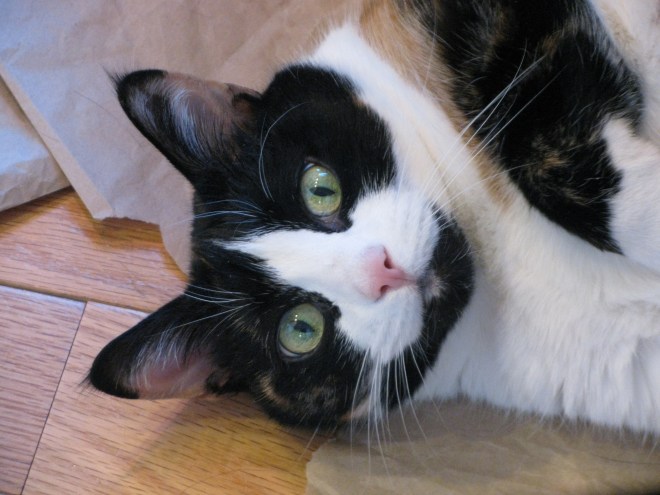
Each time there is a new loss, you’d think it would be easier but it isn’t. It’s harder. Each time they crack the heart just a little more. Each time there’s one more to remember, to meet with the other memories, the other losses. Each time you say, goodbye my love, goodbye. Thanks for being here. Thanks for your dear sweet soul.

Posted by Electric Lit
I wonder where it went, don’t you? That soul that lived a Victorian life only to leave it behind?
And then, here we are, living in the future. Sometimes it’s so much that we feel gobsmacked. Like seeing both the past and the future of our very selves, and yet even that, in this moment.
Eye of the Cosmos taken from the Hubble Telescope.

posted by Expanding Knowledge

A Father Bill Posting
Today is the feast of St. Joseph. Joe is the stepfather of Christ, according to Christian mythology. He is also the patron saint of real estate. How that happened is unknown. Perhaps miracles in his name counted by the number of mangers sold back in the day?
I buried a plastic statue of St. Joseph in the front-right corner of the yard at my house, the lovely English Tutor in Shaker Heights. When that didn’t work, after some time I (what the heck, can’t hurt, right?) buried another St. Joe in the back, outside the kitchen door. The place where all of the lovely lilies-of-the-valley grew, and Zeus the cat often hid. The lady at the crafts store where I found the last of the last St. Joseph plastic reproductions said they’d had a run on St. Joes since the real estate market decline. And no, she didn’t keep any statistics on success ratios.
Zeus continued to hide and the house did not sell. But and after all, I don’t blame St. Joe. I am a staunch hypocrite in many areas of life. How can you be Catholic and non-Catholic at once? How can you be a non-believer and expect miracles? And so I moved on without a push of Grace from the powers that be. The house was purchased (at a loss) by the company and I traveled onward, carrying only the guilt from uninterred plastic statues. (There are no instructions for post non-miracles.)
 Writers Ink—Writing and Stuff