I always loved and appreciated Stella Adler, but had forgotten all about her. At least she’s not been in the forefront of my mind for some while. So imagine my delight when I saw a new posting by an unfamiliar Facebook site. Here she is! Plus, I have a new site to follow and enjoy.
Posted by Lumonics Light and Sound Gallery. American actress, teacher, and founder of the Stella Adler Conservatory of Acting in New York City (1949). Adler’s technique is founded on an actor’s ability to imagine a character’s world. She was well known in Yiddish Theatre and Marlon Brando studied under her. She was also a compatriot of Stanislavsky. She was known for her intelligence and discipline. Creativity, of course.
I glued my fingers together because I had to repair the Angel that I knocked off the patio table.
I glued my fingers together because I had to repair the Angel that I knocked off the patio table. I knocked the ceramic Angel off the table because I whipped the cat’s mat off its head as is my wont rather than gracefully take it off.
I glued my fingers together because I had to repair the Angel that I knocked off the patio table. I knocked the ceramic Angel off the table because I whipped the cat’s mat off its head as is my wont rather than gracefully take it off. I had the cat’s mat there to air-dry out because it had gotten wet from water draining from under the hot-water heater that had leaked water after it quit producing hot water.
I glued my fingers together because I had to repair the Angel that I knocked off the patio table. I knocked the ceramic Angel off the table because I whipped the cat’s mat off its head as is my wont rather than gracefully take it off. I had the cat’s mat there to air-dry out because it had gotten wet from water draining from under the hot-water heater that had leaked water after it quit producing hot water. It had quit producing hot water because it was old.
I glued my fingers together because I had to repair the Angel that I knocked off the patio table. I knocked the ceramic Angel off the table because I whipped the cat’s mat off its head as is my wont rather than gracefully take it off. I had the cat’s mat there to air-dry out because it had gotten wet from water draining from under the hot-water heater that had leaked water after it quit producing hot water. It had quit producing hot water because it was old. The people came and replaced the old hot-water heater with a new one that leaked.
I glued my fingers together because I had to repair the Angel that I knocked off the patio table. I knocked the ceramic Angel off the table because I whipped the cat’s mat off its head as is my wont rather than gracefully take it off. I had the cat’s mat there to air-dry out because it had gotten wet from water draining from under the hot-water heater that had leaked water after it quit producing hot water. It had quit producing hot water because it was old. The people came and replaced the old hot-water heater with a new one that leaked. It leaked because people didn’t put it back together right, so more people came and put it back together right maybe.
I glued my fingers together because I had to repair the Angel that I knocked off the patio table. I knocked the ceramic Angel off the table because I whipped the cat’s mat off its head as is my wont rather than gracefully take it off. I had the cat’s mat there to air-dry out because it had gotten wet from water draining from under the hot-water heater that had leaked water after it quit producing hot water. It had quit producing hot water because it was old. The people came and replaced the old hot-water heater with a new one that leaked. It leaked because people didn’t put it back together right, so more people came and put it back together right maybe. Because there wasn’t hot water there couldn’t be cold water either so I didn’t have water yesterday or the day before or the day before that at night.
I glued my fingers together because I had to repair the Angel that I knocked off the patio table. I knocked the ceramic Angel off the table because I whipped the cat’s mat off its head as is my wont rather than gracefully take it off. I had the cat’s mat there to air-dry out because it had gotten wet from water draining from under the hot-water heater that had leaked water after it quit producing hot water. It had quit producing hot water because it was old. The people came and replaced the old hot-water heater with a new one that leaked. It leaked because people didn’t put it back together right, so more people came and put it back together right maybe. Because there wasn’t hot water there couldn’t be cold water either so I didn’t have water yesterday or the day before or the day before that at night. I had water in cups and glasses saved to use and wiped up the water that had leaked but didn’t get it all I found out when I went to move the cat mat for the people who came to fix things.
Or you can just read from here:
I glued my fingers together because I had to repair the Angel that I knocked off the patio table. I knocked the ceramic Angel off the table because I whipped the cat’s mat off its head as is my wont rather than gracefully take it off. I had the cat’s mat there to air-dry out because it had gotten wet from water draining from under the hot-water heater that had leaked water after it quit producing hot water. It had quit producing hot water because it was old. The people came and replaced the old hot-water heater with a new one that leaked. It leaked because people didn’t put it back together right, so more people came and put it back together right maybe. Because there wasn’t hot water there couldn’t be cold water either so I didn’t have water yesterday or the day before or the day before that at night. I had water in cups and glasses saved to use and wiped up the water that had leaked but didn’t get it all I found out when I went to move the cat mat for the people who came to fix things. And so because I put the cat mat over the Angel’s head I glued my fingers together. There were midge larvae—brown fat worms inside the Angel’s head—because there was an opening in her neck which is not there now because it got glued shut. But that’s another story. And the midge larvae did not survive maybe which is a good thing as they bite and are mean. The Angel is back together— deformed though, as it is difficult to work with your fingers glued together.
Maybe there should be a picture here but I don’t have one. Maybe I’ll put two up tomorrow.
The film was released on October 31 because the single was heard for the first time on October 31, 1975. It is titled like this because a “Rhapsody” is a free piece of music composed in different parts and themes where it seems that no part has any relation to the other. The word “rhapsody” comes from Greek and means “assembled parts of a song.” The word “bohemian” refers to a region of the Czech Republic called Bohemia, the place where Faust, the protagonist of the play that bears his name written by the playwright and novelist Goethe, was born. In Goethe’s work, Faust was a very intelligent old man who knew everything except the mystery of life. Not understanding it, he decides to poison himself.Just at that moment the church bells ring and he goes out into the street. Back in his room, he finds there is a dog. The animal transforms into a kind of man. It is about the devil Mephistopheles. He promises Fausto to live a full life and not be miserable in exchange for his soul. Fausto agrees, rejuvenates and becomes arrogant. He meets Gretchen and they have a son. His wife and son die. Fausto travels through time and space and feels powerful. As he grows old again he feels miserable again. Since he did not break the pact with the devil, the angels dispute his soul. This work is essential to understanding Bohemian Rhapsody.
The song talks about Freddie Mercury himself. Being a rhapsody we find 7 different parts:
1st and 2nd act A Capella
3rd act Ballad
4th act guitar solo
5th act opera
6th act rock
7th act “coda” or final act
The song talks about a poor boy who questions if this life is real or if it is his distorted imagination that lives another reality. He says that even if he stops living, the wind will continue to blow without his existence. So he makes a deal with the devil and sells his soul.
Upon making this decision, he runs to tell his mother and tells her…
“Mom, I just killed a man, I put a gun to his head and now he’s dead. I have thrown my life away. If I’m not back tomorrow, move on as if nothing matters…” That man who kills is himself, Freddie Mercury himself.
If he does not fulfill the pact with the devil, he will die immediately. He says goodbye to his loved ones and his mother bursts into tears, tears and desperate crying that come from Brian May’s guitar notes. Freddie, scared, shouts “mom, I don’t want to die” and the operatic part begins. Freddie is in an astral plane where he sees himself: “I see a little silhoutte of a man.” “scaramouche, are you going to start a dispute/fight?”
Scaramouche is “skirmish” a dispute between armies with horse riders (4 horsemen of the evil Apocalypse fight against the forces of good for Freddie’s soul) and it goes on to say “Thunderbolt and lightning very very frightening me” too much). This phrase appears in the Bible, exactly in Job 37 when it says… “the thunder and lightning frighten me: my heart pounds in my chest.” His mother, seeing him so scared by the decision her son has made, begs to save him from the pact with Mephistopheles. “He’s just a poor boy…” He forgives his life for this monstrosity. What comes easy, goes easy. Will you let him go? ” Their supplications are heard and the angels descend to fight the forces of evil.” Bismillah (Arabic word meaning “In the name of God”) is the first word that appears in the Muslim holy book, the Quran. So God himself appears and shouts “we will not abandon you, let him go.”
Faced with such a confrontation between the forces of good and evil, Freddie fears for the life of his mother and tells her “Mama mia, mama mia let me go” (mother, let me go). They shout again from the sky that they are not going to abandon him and Freddie shouts “no, no, no, no, no” and says “Beelzebub (the Lord of Darkness) may have put a devil in you mother.” Freddie here pays tribute to Wolfgang Amadeus Mozart and Johann Sebastian Bach when he sings… “Figaro, Magnifico” referencing Mozart’s “The Marriage of Figaro”, considered the best opera in history, and Bach’s “Magnificat” . He finishes the operatic part and the more rock part breaks in. The devil, angry and betrayed by Freddie by not fulfilling the pact, tells him “Do you think you can insult me like this? Do you think you can come to me and then abandon me? “Do you think you can love me and let me die?”
It is shocking how the lord of evil feels powerless before a human being, before repentance and love. Once the battle is lost, the devil leaves and we reach the last act or “coda” where Freddie is free and that feeling comforts him. He sounds the gong that closes the song. The gong is an instrument used in China and Far East Asia to heal people who are under the effects of evil spirits.
5:55 minutes last. Freddie was into astrology and 555 in numerology is associated with death, not physical, but spiritual, the end of something where angels will safeguard you. 555 is related to God and the divine, an ending that will begin a new stage.
And the song plays on All Saints’ Eve for the first time. A holiday called “Samhain” by the Celts to celebrate the transition and opening to the other world.
The Celts believed that the world of the living and the dead were almost united, and on the day of the dead both worlds were united, allowing the spirits to transit to the other side. Nothing in Bohemian Rhapsody is coincidental.
Everything is very measured, worked and has a meaning that transcends beyond being a simple song. It has been voted worldwide as the best song of all time.
This song represented a radical change in Queen as if she had really made a pact with the devil, she changed their lives forever and made them immortal.
I thought this was interestingly of note and a break from the “wallows,” aka wallowing. Of course there is the loss of Freddie, but we can still celebrate him and his music.
So the kid will be in Aveiro, Portugal this coming Wednesday, the 24th of April. She’ll be staying there a while without returning to the States in order to fulfill the Portugal citizenship requirements. I’m not sure how long, but it’s at least for six months that she must not leave. So I’m sure she’ll be speaking fluent Portuguese the next time I see her in person. The question is will it be with me visiting there? Or will it be with a trip back for her? Her partner will be joining her once she is finished teaching for this year. That looks to be some point in June. They have a lovely flat already leased from which they will operate at least for a while. They do plan on buying a house there.
So.
Do I visit? Likely in about six months or so. Without the cats. I would need to find someone to come care for them while I am gone. Not really impossible…I know people I could ask. I could evaluate then, to move or not to move to Aveiro. Moving to another country is not easy. Visa. Parting with “stuff.” Selling “stuff.” Moving “stuff.” Going to D.C. (Visa). FBI. Government appointment. Stuff.
Moving with cats. Holy cuss words.
This is not a decision for today. I know that. I also know she will be gone in four more days. Sometimes I don’t have a center to orient to. There is no such thing, I remind myself. I remind myself of lots of things. Some of them make sense.
It suddenly dawns on me that she will be officially and really there on my son’s birthday. The 24th of April. Yeah, that day.
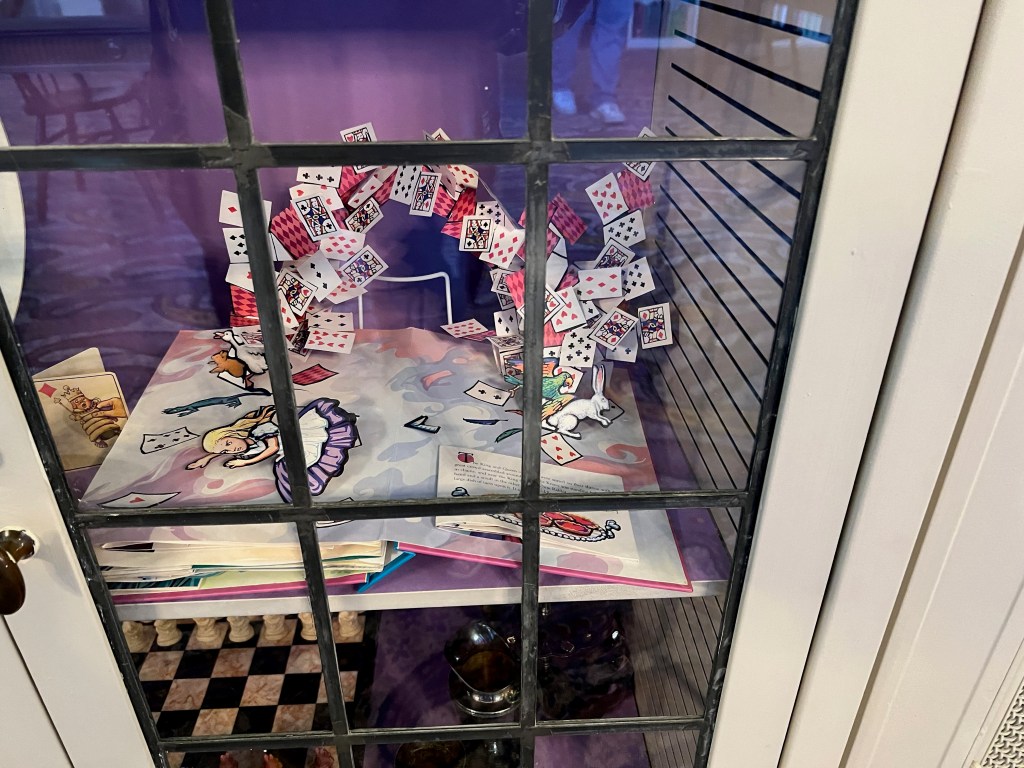
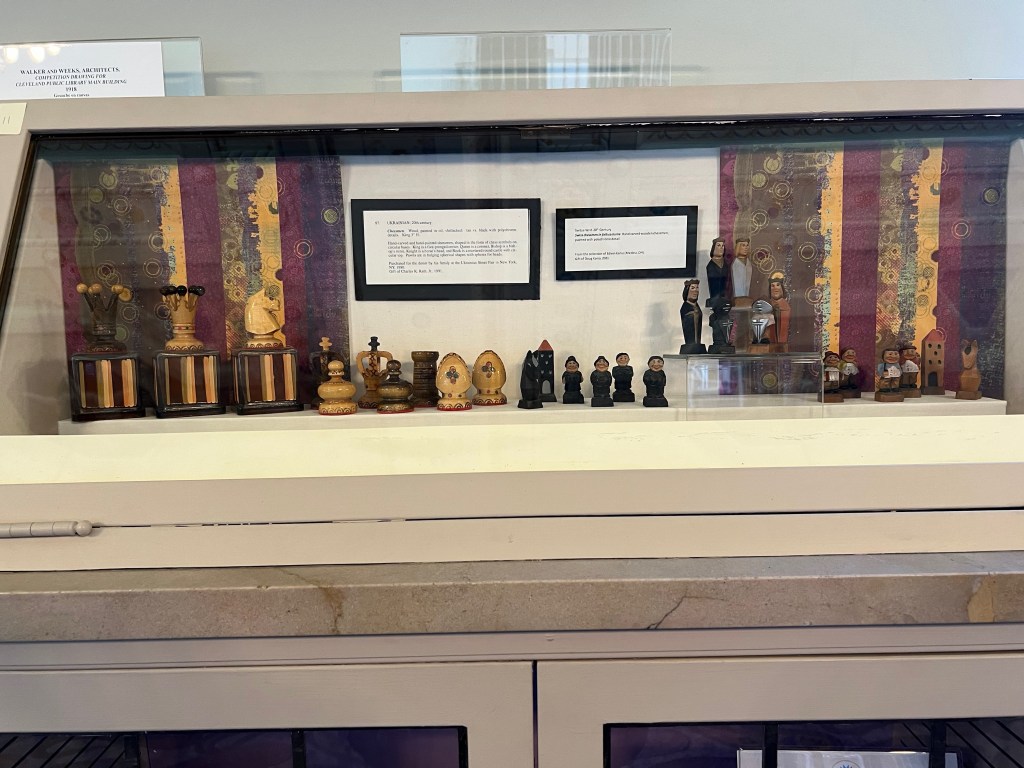
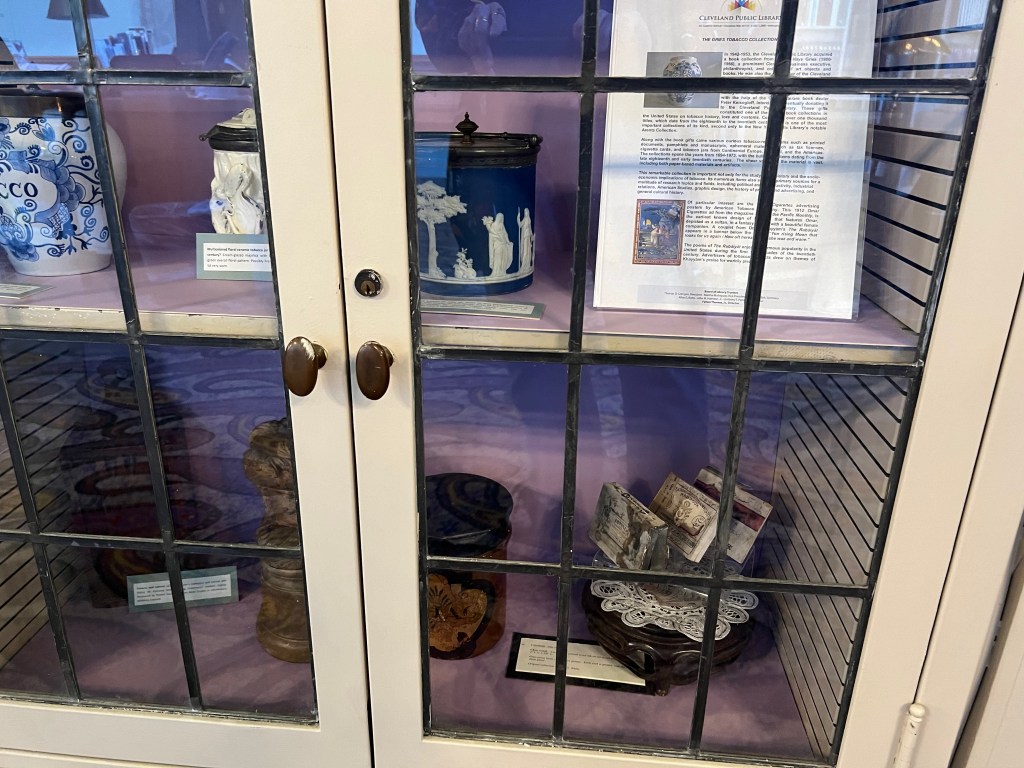
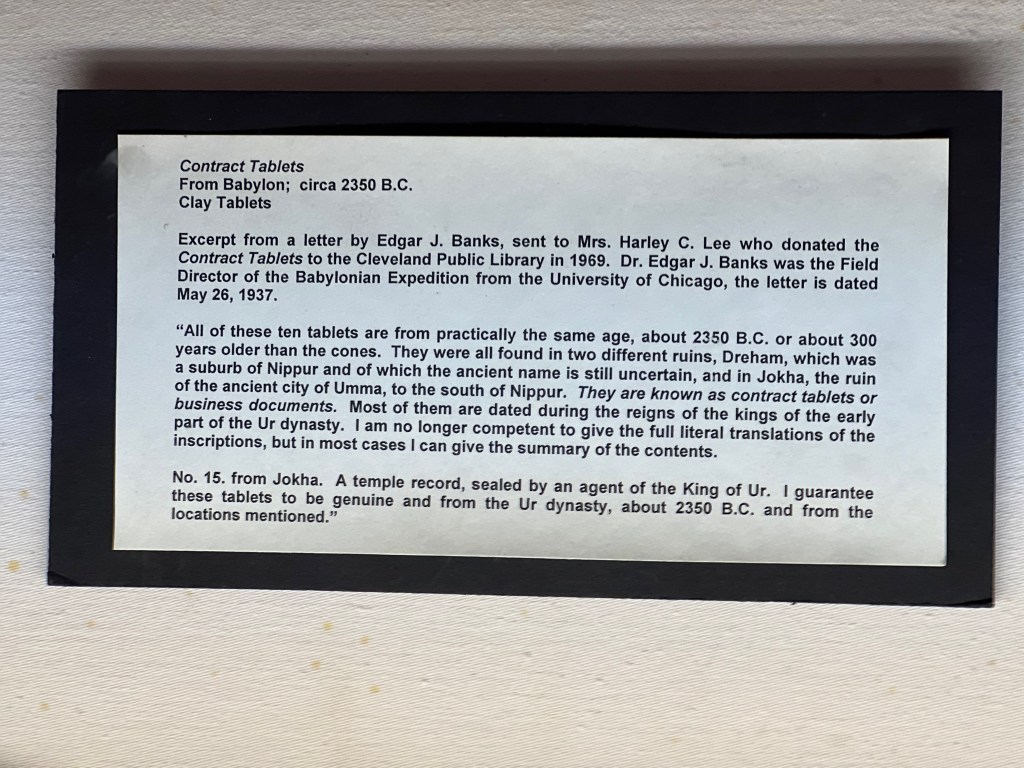
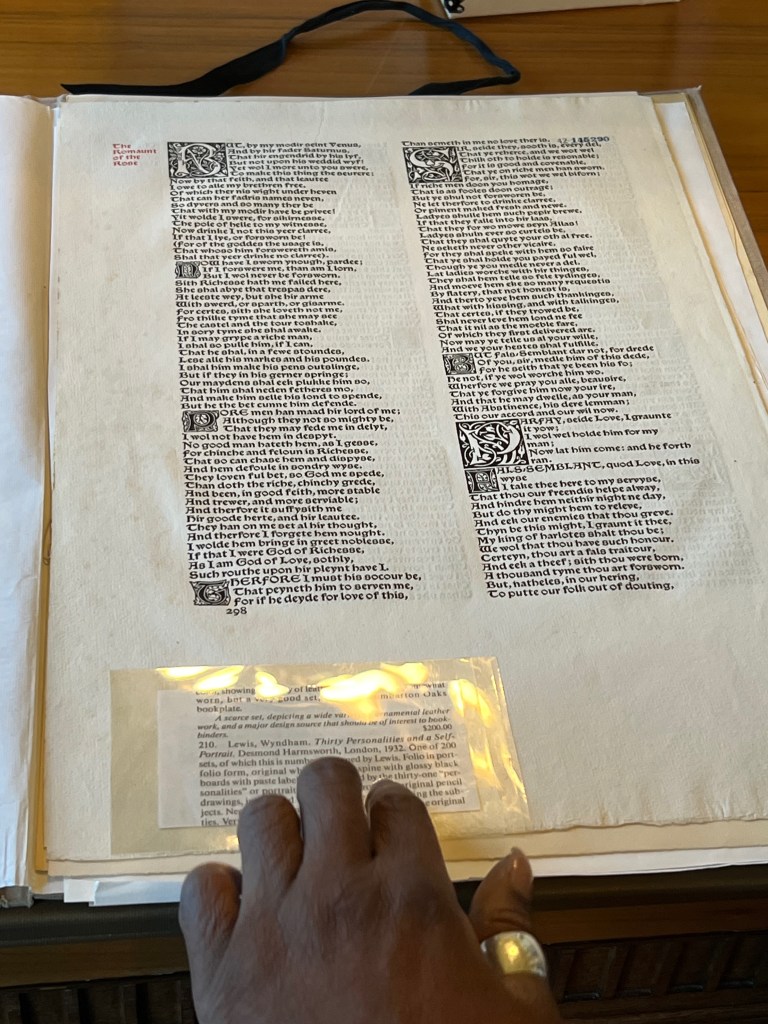
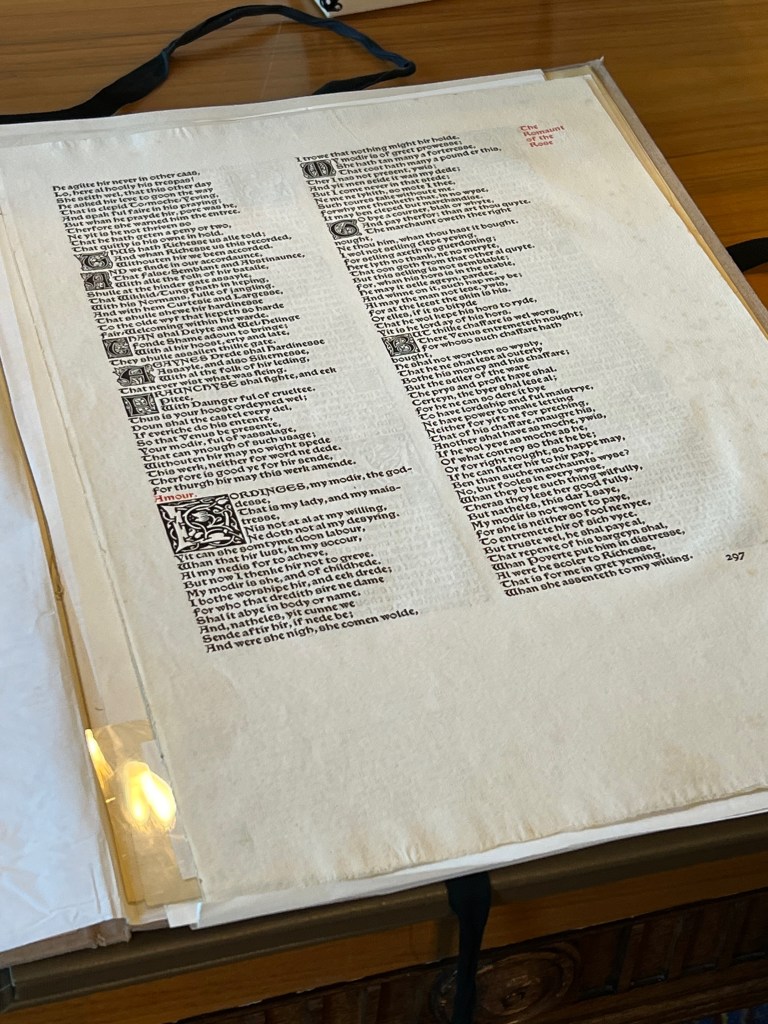
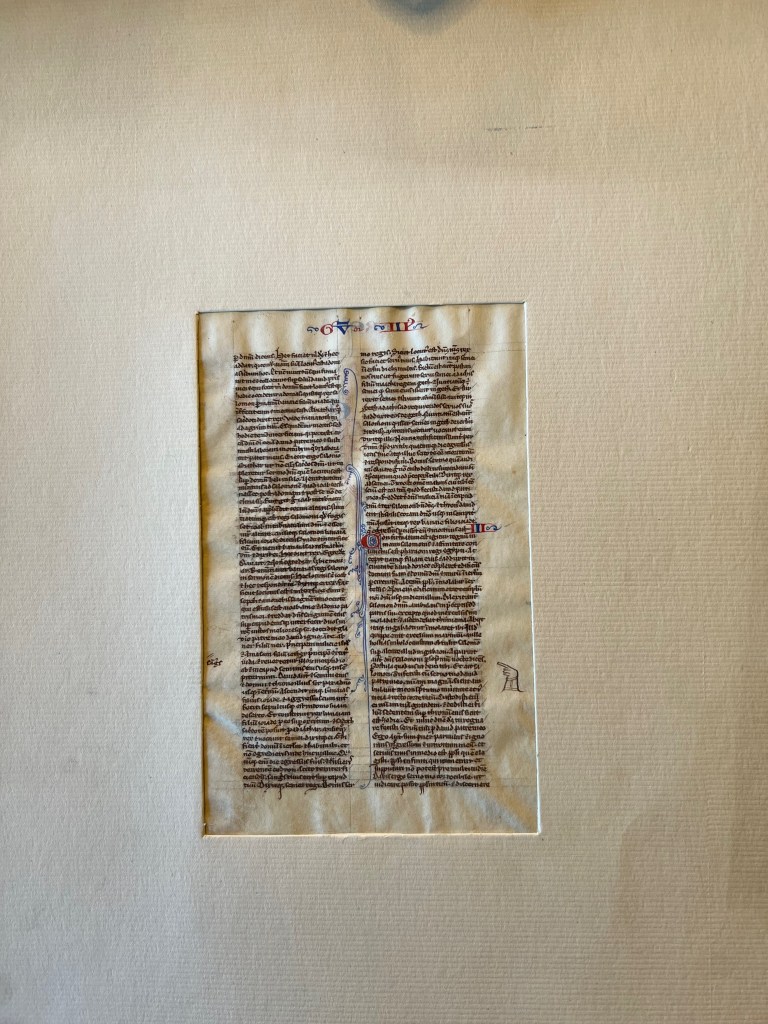
Well then and there. A surprise that someone currently living in Japan told me about: The World of Chess in Ohio. Wow. So here we are with a visit to the downtown Cleveland Public Library on the third floor of the main building, and a step into the rabbit hole. I took a few photos (not of everything or all) in order to put into a slide-show. (Which I couldn’t do today for some reason, but will try later.)
The lovely Stacy took us around and also pulled out of the archives for us—original hand-written folio sheets from as long ago as the middle ages (Chaucer), unrelated to chess, and little books—see the only person photo, and the skull on the desktop. Somehow I lost the other photos of little books. The one in the photo below is of Hamlet. I now have a new appreciation for little books and learned their purpose, which was to hide and smuggle information where it was not welcome or illegal. Many of them are quite incredible works of art.
For those who don’t know, the second photo below is of Bobby Fischer playing chess and the third is of Boris Spassky, famously defeated in Laugardalshöll arena in Reykjavík, Iceland, by our own Bobby. People from all over watched the brilliant encounter and final chess game, even those who had never heard of it before. Bobby, a grandmaster, won the tournament to become the reigning chess king of the world in 1972. He eventually disappeared, chased by the U.S. trying to arrest him for playing chess where sanctioned. He was eventually found in Iceland where his mental decline into madness was obvious and where he died in 2008. He went back there as it was the only county to offer him citizenship.
From Wikipedia: Robert James Fischer (March 9, 1943 – January 17, 2008) was an American chess grandmaster and the eleventh World Chess Champion. A chess prodigy, he won his first of a record eight US Championships at the age of 14. In 1964, he won with an 11–0 score, the only perfect score in the history of the tournament.
All of the exhibits in the library are donated, and they may be freely photographed. The John G. White collection takes up all of the floor in that wing and includes books on chess as well as the notes of famous chess players, game cards (with the moves noted) as well as the chess sets from the centuries and world.
Ohio’s own Calvin Blocker won the International Master title in 1982 and continues to play upon occasion. He will be appearing at the White-collection room this month where he will be playing several at once. He is often described as an eccentric who loves the game of chess. He is also said to be an absolute grandmaster player who has all but the title (as he will not leave the state of Ohio to play). The chess floor entertains regular chess games and competitions where it is not unusual at all to see Blocker.
My friends and I spent the afternoon there. I personally could have spent the day and come back for more.
P.S. Apparently all you have to do is click on any of the photos and you’ll get a slide show. To start at the beginning, select the first photo.