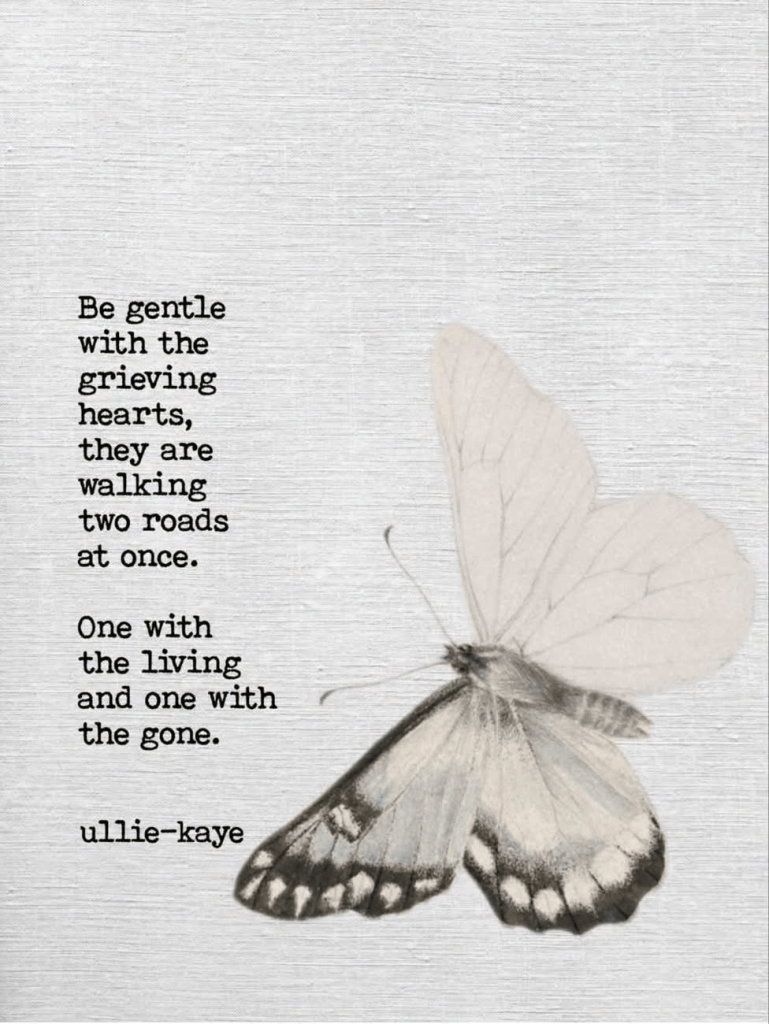
It needs to be said that the most painful of all losses are those we suffer outside of public view. Those are the losses that are rarely written about, the losses that leave us with part of our souls gone and the days that will forever be missing the breath of another.
We have had a year of treasured public icons gone from our lives. One of the most significant of the adored is Dolly Parton, dead, gone from the human domain. On the night of Tuesday, August 25, 2026, the Empire State Building’s tower lights sparkled in pink from 9:25 p.m. to 10:25 p.m. as a tribute to Parton, who died the same day. Her songs were sung and played throughout the nation. Other countries, the world mourned her loss and named her accomplishments, generosity, and compassion.
Every death, every new reminder, serves to push at what had been a momentary pause in our own stone storehouse of loss. Stunning or surprising, we add another to our of mansion of memories, integral pieces of the lives that once were.
Grief is just a word. Yet the pain that it resurfaces unites all parts of us. Our mind, our body, our soul become one in pain. The worst of it is when we dream and the dream conjures the dead one—the child’s hand, the words, the soft brown eyes of the dog barking at the door, the young man walking toward me. And then we awaken. And then learn all over again it wasn’t a mistake at all. We are empty.
To say some of the things we hear said are puzzling only speak to our loneliness. “As long as someone lives in another’s memories, they are not dead.” How can that possibly make any sense? Yes they are. They are not here. “Well at least she’s at peace now.” She maybe, but I’m not. Not yet. We know that the loss happens to us, not to the dead.
Things fall apart.
After the first pains of mourning we play memory tributes. Those words of “remember when.” With the wonderful famous people who die, we can make public honors. We can acknowledge them and their good works. Most important, they can represent the stages in our lives. They sing not only of when we were, but who we were becoming and would become. Perhaps even who we still will become.
These are the ones I’ll forever be grateful to. These are the ones for whom I feel honored to have had them in my life.
GLORIA STEINEM
The Truth will set you free, but first it will piss you off
The film was released on October 31 because the single was heard for the first time on October 31, 1975. It is titled like this because a “Rhapsody” is a free piece of music composed in different parts and themes where it seems that no part has any relation to the other. The word “rhapsody” comes from Greek and means “assembled parts of a song.” The word “bohemian” refers to a region of the Czech Republic called Bohemia, the place where Faust, the protagonist of the play that bears his name written by the playwright and novelist Goethe, was born. In Goethe’s work, Faust was a very intelligent old man who knew everything except the mystery of life. Not understanding it, he decides to poison himself.Just at that moment the church bells ring and he goes out into the street. Back in his room, he finds there is a dog. The animal transforms into a kind of man. It is about the devil Mephistopheles. He promises Fausto to live a full life and not be miserable in exchange for his soul. Fausto agrees, rejuvenates and becomes arrogant. He meets Gretchen and they have a son. His wife and son die. Fausto travels through time and space and feels powerful. As he grows old again he feels miserable again. Since he did not break the pact with the devil, the angels dispute his soul. This work is essential to understanding Bohemian Rhapsody.
The song talks about Freddie Mercury himself. Being a rhapsody we find 7 different parts:
1st and 2nd act A Capella
3rd act Ballad
4th act guitar solo
5th act opera
6th act rock
7th act “coda” or final act
The song talks about a poor boy who questions if this life is real or if it is his distorted imagination that lives another reality. He says that even if he stops living, the wind will continue to blow without his existence. So he makes a deal with the devil and sells his soul.
Upon making this decision, he runs to tell his mother and tells her…
“Mom, I just killed a man, I put a gun to his head and now he’s dead. I have thrown my life away. If I’m not back tomorrow, move on as if nothing matters…” That man who kills is himself, Freddie Mercury himself.
If he does not fulfill the pact with the devil, he will die immediately. He says goodbye to his loved ones and his mother bursts into tears, tears and desperate crying that come from Brian May’s guitar notes. Freddie, scared, shouts “mom, I don’t want to die” and the operatic part begins. Freddie is in an astral plane where he sees himself: “I see a little silhoutte of a man.” “scaramouche, are you going to start a dispute/fight?”
Scaramouche is “skirmish” a dispute between armies with horse riders (4 horsemen of the evil Apocalypse fight against the forces of good for Freddie’s soul) and it goes on to say “Thunderbolt and lightning very very frightening me” too much). This phrase appears in the Bible, exactly in Job 37 when it says… “the thunder and lightning frighten me: my heart pounds in my chest.” His mother, seeing him so scared by the decision her son has made, begs to save him from the pact with Mephistopheles. “He’s just a poor boy…” He forgives his life for this monstrosity. What comes easy, goes easy. Will you let him go? ” Their supplications are heard and the angels descend to fight the forces of evil.” Bismillah (Arabic word meaning “In the name of God”) is the first word that appears in the Muslim holy book, the Quran. So God himself appears and shouts “we will not abandon you, let him go.”
Faced with such a confrontation between the forces of good and evil, Freddie fears for the life of his mother and tells her “Mama mia, mama mia let me go” (mother, let me go). They shout again from the sky that they are not going to abandon him and Freddie shouts “no, no, no, no, no” and says “Beelzebub (the Lord of Darkness) may have put a devil in you mother.” Freddie here pays tribute to Wolfgang Amadeus Mozart and Johann Sebastian Bach when he sings… “Figaro, Magnifico” referencing Mozart’s “The Marriage of Figaro”, considered the best opera in history, and Bach’s “Magnificat” . He finishes the operatic part and the more rock part breaks in. The devil, angry and betrayed by Freddie by not fulfilling the pact, tells him “Do you think you can insult me like this? Do you think you can come to me and then abandon me? “Do you think you can love me and let me die?”
It is shocking how the lord of evil feels powerless before a human being, before repentance and love. Once the battle is lost, the devil leaves and we reach the last act or “coda” where Freddie is free and that feeling comforts him. He sounds the gong that closes the song. The gong is an instrument used in China and Far East Asia to heal people who are under the effects of evil spirits.
5:55 minutes last. Freddie was into astrology and 555 in numerology is associated with death, not physical, but spiritual, the end of something where angels will safeguard you. 555 is related to God and the divine, an ending that will begin a new stage.
And the song plays on All Saints’ Eve for the first time. A holiday called “Samhain” by the Celts to celebrate the transition and opening to the other world.
The Celts believed that the world of the living and the dead were almost united, and on the day of the dead both worlds were united, allowing the spirits to transit to the other side. Nothing in Bohemian Rhapsody is coincidental.
Everything is very measured, worked and has a meaning that transcends beyond being a simple song. It has been voted worldwide as the best song of all time.
This song represented a radical change in Queen as if she had really made a pact with the devil, she changed their lives forever and made them immortal.
I thought this was interestingly of note and a break from the “wallows,” aka wallowing. Of course there is the loss of Freddie, but we can still celebrate him and his music.
“Music is a system of harmonic relationships inherent within the quantized fractal structure of the cosmos.” ~ Marshall Lefferts
Posted by Nassim Haramein
Someone else said that the Universe was, at the center, a chord that was the sound of God. And that’s what makes everything run, orbit, spin, hum, and sing out with Life. A famous conductor said those basic words more or less. That is also more or less the same thing as said by Lefferts.
Of course that means Death also, as there is no Life without Death. (Being made to occur from a chord somewhere in the center of the Universe or Cosmos.) I always wonder things from that point such as, what is the cord? Is it a C cord? That’s what immediately jumps to mind. But then that’s nothing mysterious and shouldn’t it be mysterious? Is it the secret cord that David played before the Lord according to Leonard Cohen? And what happens if The Chord goes silent? Yes, the End, naturally, but how? A major massive explosion? A complete disappearance? An Absolute Nothing? And does something ever occur if there is no one to bear witness? If there is no one to see or note that something once was, was it ever so?
If I had the head for it I’d attend the course: Explore the universe of frequency, vibration and resonance in the free Unified Science Course in the Resonance Academy at ResonanceScience.org. But I’m afraid it would be much beyond my capabilities. Although I do adore fractals.
Wait…wait…does the Chord ever change? As much as it causes, is it affected by? Does its color or tone change with major events? I see my mind as a child hopping about on one foot to another, unable to stay still for learning. I’d like to have a few words with this Secret Chord!
Clara Schumann is rumored to have had an affair with Johannas Brahms, an idea pooh-poohed by many. Just look at the size and shape of that guy, yes? And yet, he—like many of the rest of us—looked quite different as a young man. He was said to be quite handsome and dashing as a younger. Ah yes, and a musician too. What better than the electricity of sexual attraction to someone who has everything going for him? Add to that that her husband, while a grand musician and composer, was a bit off the beam. Playing at A-flat, so to speak.
Robert Schumann did create many beautiful things, including some of my favorite piano pieces. Perhaps I’ve said this before, if so, apologies: When questioned about where the music or inspiration came from, he replied it was in his mind. He just had to write it down. The questioner said how marvelous that must be. Good God no! He replied. How would you like that *****###### in your head all the time. You can’t get rid of it!
Poor man, it did indeed drive him crazy. And then there’s the incident of the hand. Pianists like to have an octave-and-beyond reach for chords. The farther the better. Robert therefore bound his hand(s?) with his fingers stretched out while he slept in an attempt to improve his reach. In doing so he crippled them. Imagine the horror—a pianist who cannot use his hands to play properly—and at his own doing. Eventually Schumann died in a mental asylum, although he had—again, like more than one musician/composer—attempted suicide more than once.
Rachmaninoff is reputed to have the largest hands measured with a span of a 12th… C – G’ in easy playing, not just stretching. That explains some of his chord progressions. He too, as with many musicians, went off the beam now and again, especially suffering from depression. To resume his career at one point he consulted a hypnotist who seems to have benefited his return to the concert stage.
I find it puzzling why many people ask creatives—writers, artists, composers, et.al.—where they get their ideas. Such an odd question, and one impossible to answer. Let it suffice to say it’s many things, not the least of which is craft—after the inspiration—work, work, work.
And no, not everyone who creates goes crazy or kills herself. The demons land where they must.
Posted by Classic FM
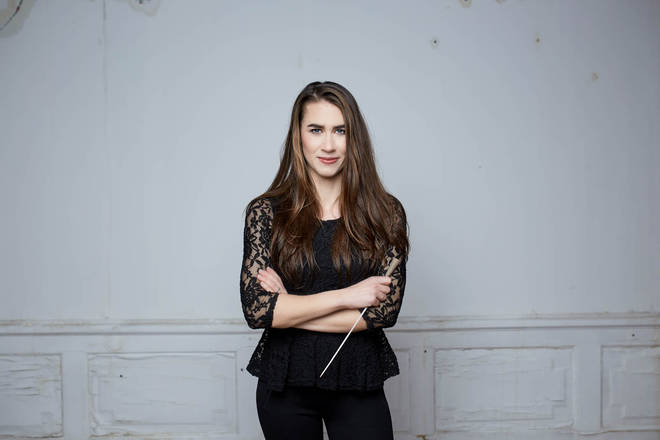
Conductor Marta Gardolinska: Our jobs are similar to those of sports people’s high pressure and physical strength is needed…”
Above and below posts by Classical FmThis is a marked-up score of a conductor. It is for a piece by Mahler. This is interesting as most people think of a conductor as just waving his baton around to a score he knows. It’s a bit more complicated than that. While I am not personally a fan of Mahler, his skill and abilities can certainly be seen—or rather, heard. Below is the artist as a young man.



 Above and below posts by Classical Fm
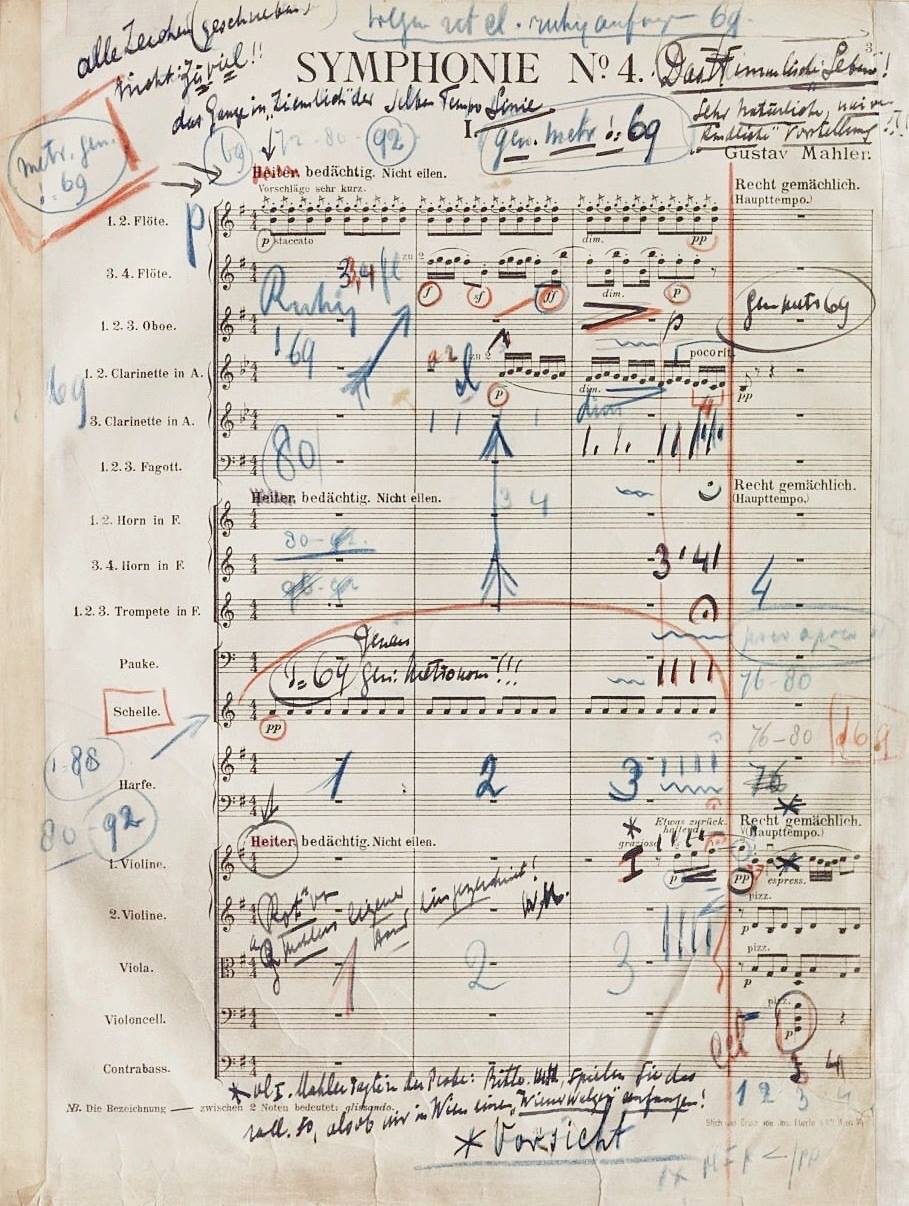 This is a marked-up score of a conductor. It is for a piece by Mahler. This is interesting as most people think of a conductor as just waving his baton around to a score he knows. It’s a bit more complicated than that. While I am not personally a fan of Mahler, his skill and abilities can certainly be seen—or rather, heard. Below is the artist as a young man.

