Posted by Thinking Minds
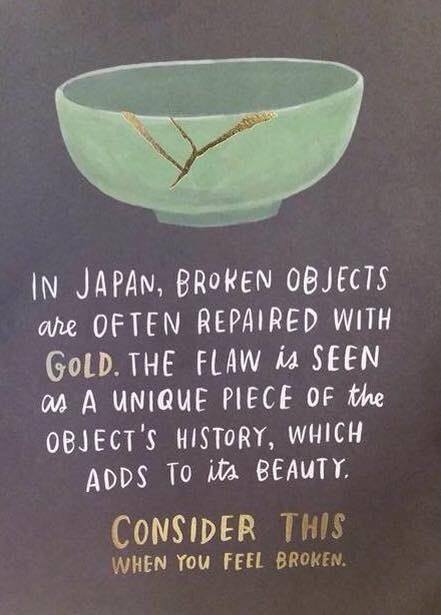
What a wonderful attitude. And it is true of those things in our lives we choose to make into works of art, those things that are crooked, or peeled or lopsided. And so also of people and relationships. Why not?

Posted by Thinking Minds
What a wonderful attitude. And it is true of those things in our lives we choose to make into works of art, those things that are crooked, or peeled or lopsided. And so also of people and relationships. Why not?
As I thought, and as I am so predictable:

Quantum World: Awaken Your Mind
But then it was a rather enjoyable venture as I didn’t have any pressure on myself. You know, meeting expectations and all that! Which makes the contemplation of GUILT inevitable also, doesn’t it?
Of late thoughts turn to—why do we have guilt? What purpose that? For myself the origin is pre-Catholic as I recall being a tiny child and feeling guilty about something, not wanting to tell my mother. OK, so origin is with parents. And of course there are those childhood pals who gasp in horror or encouragement while clearly specifying the wrongness of something. (Society.) Then, for those of us with religious strictures, there is the Catholicism of life. Little chance then, to manage as an adult without the burden—very heavy burden—of a huge guilt container forever lurking in the back, or very foundation even, of the Mind. It seems to me that after a certain point, Guilt is no longer needed or required to direct a life. Direction is no longer needed. So why the very potential of something Wrong awakes the Monster Guilt, perched in waiting, is beyond me.
No, we don’t need Guilt to keep us on the path of Good when there are choices. No, we don’t need Religion in order to be moral beings.
And then and also, don’t we have something inside that slams the door on Guilt and guides us beyond those limits? That something that fires up Curiosity and Approval when we absolutely know that the Rules, Laws, Controls, are just plain Wrong?
Of course. Copernicus, Galileo, and me.
Nightwood, Barnes’ best novel, has the distinction of being the only lesbian-themed Modernist gem to garner praise, and an introduction, from arch-conservative T.S. Eliot. Before writing it, Barnes was born in a log cabin, raped as a teen, and lived as a Bohemian journalist in Greenwich Village. She was ahead of her time in just about every way possible, even pioneering the kind of New Journalism that wouldn’t catch fire until mid-century. A poet, novelist, playwright, and illustrator, Barnes exemplified both the glory and isolation that come with being a perpetual outsider. Hemingway wouldn’t have known what to make of her.

This from Book Riot’s piece on “Five Women Writers Tougher Than Hemingway,” which is why the ending sentence is a reference to Hem.
And I went to get my copy of Nightwood so I could snap a photo of said book, the one we are chatting about here. I could not find it. This will—no doubt, no doubt at all—lead to the great Rabbit Hole Adventure of August 16. I’ll look for the book, have to rearrange some bookshelves (technically the books on the bookshelves), then stop to play on the keyboard, then maybe…
And so of the day, to make much of the lovely Djuna. And there is so much more to say about her. But I must go look for the book.
He, along with Bird Parker and many other Jazz Greats, often played for Jazz at the Philharmonic, JATP. Their records did a lot to publicize and further instill Jazz as an up and coming musical form. That is, beyond those places and states where it seems the music of jazz was a way of life, born before records themselves. That was mainly in the south, and then New York, Detroit, and Chicago.
Luckily, I managed to hang on to the JATP among my collection, and I still have them. Of course occasions such as this prompt me to play some of that music! And jazz, it seems for many of us, must be played loudly.

Published by Quartz Magazine
There’s no clear way of evaluating consciousness in other animals (or in other humans, for that matter—it’s quite possible that you’re the only conscious being alive and everyone you know is merely displaying signs of consciousness rather than truly experiencing it). But we can certainly make educated guesses. Broadly speaking, consciousness is often defined as there being an experience of what it’s like to be said creature. (This notion is explored in depth in philosopher Thomas Nagel’s essay, “What is it like to be a bat?”)
Octopuses display signs of curiosity, and Godfrey-Smith believes it’s extremely likely that they’re conscious beings. “I think the exploratory behaviors, the fact that they attend to things, they have good eyes, they evaluate, are little bits of good evidence that there’s something it’s like to be an octopus…”
I have found the magnificent octopus endlessly fascinating. Unfortunately, our history with them—as is mostly the case with other creatures—is not glorious. But, on the positive, we have just begun to really study and respect them.
A story comes to mind of an oceanic explorer who has spent some time with them. He is astounded by their curiosity and friendliness. He does warn, however, to not give them a retractable measuring tape if you want it back. You won’t get it returned. They love them and seem to have found an endless study and application for them. I personally believe they’re just playing with them. Who wouldn’t?
About consciousness—that’s another topic, just hinted at here. Later for that.

 Writers Ink—Writing and Stuff