And practicing Sloth, a view of early Christian woman who broke a few rules and lived to punish themselves. I also came across these rather clever—if not entirely respectful—images from Atlas Obscura.
This slideshow requires JavaScript.
But, my all time favorite from the list of early Christian women radicals, a true, productive, and accomplished radical: Our Dear Saint Hildegarda. She, fighting against the constraints, and sometimes evil patriarchal system, wrote songs that hid the full severity of her criticisms. She was much more direct in her criticisms of the Church and hierarchal system when she wrote to other women. While preaching, writing, singing, and praying, she also managed to create her own language. The language, a Lingua Ignota (Latin for unknown language) was described by her and apparently used for mystical purposes. [Is this the “speaking in tongues” become writ?]
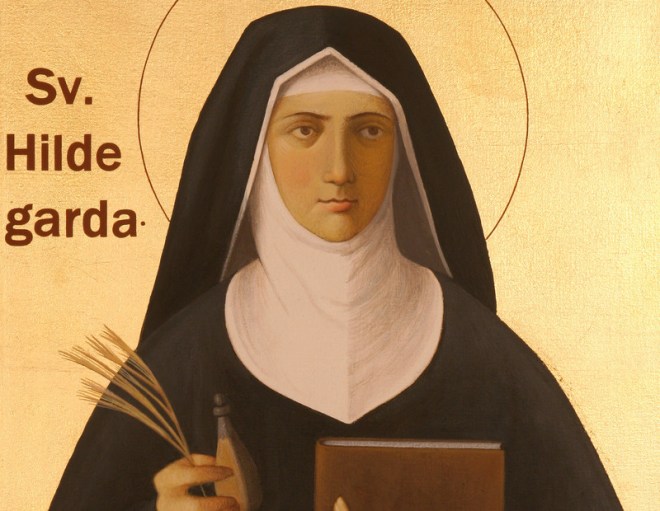
More on our dear Hilde: Hildegard of Bingen (1098-1179) was a remarkable woman, a “first” in many fields. At a time when few women wrote, Hildegard, known as “Sybil of the Rhine”, produced major works of theology and visionary writings. When few women were accorded respect, she was consulted by and advised bishops, popes, and kings. She used the curative powers of natural objects for healing, and wrote treatises about natural history and medicinal uses of plants, animals, trees and stones. She is the first composer whose biography is known. She founded a vibrant convent, where her musical plays were performed. Although not yet canonized, Hildegard has been beatified, and is frequently referred to as St. Hildegard. Revival of interest in this extraordinary woman of the middle ages was initiated by musicologists and historians of science and religion. Less fortunately, Hildegard’s visions and music had been hijacked by the New Age movement, whose music bears some resemblance to Hildegard’s ethereal airs. Her story is important to all students of medieval history and culture and an inspirational account of an irresisible spirit and vibrant intellect overcoming social, physical, cultural, gender barriers to achieve timeless transcendence.
 This depiction is showing the inspiration of the Holy Ghost, or Spirit in the form of the fire that enters her head (mind) from above.





 oma Christian University, honors student Amelia Hamrick performed the 27-second piece of music that she discovered on a more than 500-year-old painting by Hieronymus Bosch. And what did she call the music she played and posted? Why, Butt Music, of course.
 Writers Ink—Writing and Stuff