[from today, work in process and not proofed]
Then
It was beautiful. The scents wrapped themselves around you as soon as you went down the road. It was a warm-wet smell, run through with mud and wild herbs and animals, tall grasses and pussy willows and cat ‘o nine tails. Wild violets grew there, and swamp trillium and sometimes wild iris.
The two-track dirt road ran from a turn off right before the bridge that spanned the river. The cottages began to appear in a staggered order once past the first turn. The initial ones sat directly on a slab or on cement blocks which raised enough to see through them underneath, a view of the beds of raccoons and other small creatures when the river hadn’t flooded the year before. Further on down the road the cottages sat on stilts, mostly painted the same color as the houses, sand brown, stadium green, and mud brown, the same color as the river, the muddy Mississippi. It must be admitted that it wasn’t below some people to paint a mixture between top and bottom, sometimes even side to side or half-way up somewhere. After all, even if you hadn’t run out of paint, why waste any? In summer the trees filled out with their many colored green shades to block the view ahead, until you came right upon the clearing that had allowed the building of the homes, most with their stairs going straight up to front doors and small, utilitarian decks that only allowed for equally small rowboats or skiffs to be stored there. No one sat on decks for fear of the huge mosquitoes large enough to carry away a small child.
Find picture of bridge to insert here.
Motorboats were docked at the river’s edge. During the winter they were stored in boathouses or inside the cabins themselves, back end, aside of the kitchen. Any porches were screened in. Some of the places had bedrooms and indoor plumbing, but not all. A bed is a bed—what difference does it make where it goes? It’s only going to be slept in. And, if you have electricity, you can watch TV to fall asleep to. Coleman lanterns and sometimes Coleman stoves. Fire pits in front yards with cooking pots bubbling turtle stew. Smoke houses with their own billows piped out into the air filled with cricket and frog noises. Birds calling, loons after dark, owls, king fishers.
It was rumored that once, years back, there had been a long house where the road ran out. It was a place where folks played instruments, danced, and drank beer. If you wanted anything stronger you had to bring your own bottle. But folks gathered there, even if it was only to fry your fish—crappies, sunfish, and pike—and potato patties, ears of corn, on the stone grills outside. And listen to the stories. Most of the stories were tales about the monsters in the very deep of the river: forty-pound catfish, bodies of dead men loosed from anchor ropes, turtles the size of small cars that could dive and hold their breath for an hour. Then too, the snapping turtle that had clawed their would-be captor’s face to shredded meat and yet another who had snapped off a whole hand at the wrist. The alligator snapper, of course. These tales that at their backbone carried truth, sent shutters through small children and some adults. Still, some were willing to try for the capture of a good sized snapper as he made the best turtle stew, had more meat, and was easier to clean up and prepare.
Find picture of cabin to insert here.
Most of the people who live Under The Bridge lived there year round. Some, it is said, only live there in the spring and summer, sometimes autumn. Yet there is another area, an off trail at the start of the two-track. The people who lived there all did so year round, in the tents they had pitched or in the cardboard sheds they had put together. You could walk to the make-shift settlement there from downtown, or the warehouses. It was easy there to ask for food, or take it from the boxes that were left by the large truck doors, where the trucks drove in and unloaded. The crates mostly held fruits and some vegetables. They were the ones that had wilted or fallen out of the shipping crates while being transported. By the end of the day all of the crates had been emptied.
One person who camped at the bridge settlement had a truck. That was when the state had long ago required driver plates on vehicles. The state had, but cities were slow to follow, especially small towns. But by this time, the city had begun the insipient capture of all legally defined passenger vehicles. The Bridge Guy however, was exempt. The cops turned a blind eye when the rusted and rattled old truck made its way thru the town, often helping someone move in or out of the bridge settlement. The driver, a strange man with a said-to-be torrid past, (it was rumored he had killed someone with an axe, years before) was not one to be messed with. Any of the kids who decided to torment soon learned better. When he jumped out of the truck to pursue anyone who dared, they left shaken and panting. He had a variety of nicknames which he lived up to: the flash, truck man, who-do Harley for a few. It helped that he was tall and big, ugly, bearded, and never spoke, only growled. And certainly no one went to the bridge settlement when it was dark.
It all provoked a harmony of sorts. Things were as they were and that was that. The river flowed and the people moved around it. When the river left its banks and moved beyond the road, the settlement moved out. When the river regained itself and it was dry enough, they moved back in. Life went on, moving with the current.
NOW
The road and trail have been closed off. It’s impossible to see where they were, only tell-able by the feel of knowledge. What was. Of course the people who had lived there are long gone along with the cottages that were torn down. Their children might remember but their children in turn, aren’t interested in what was and is now invisible. After all, it’s just a memory. And the memory belongs to someone else.
But there has been a replacement …. continue from here (and don’t forget Dead Man’s Slough)



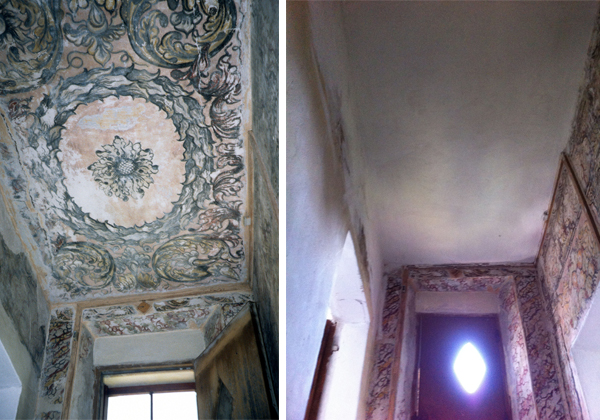 The ceiling in 2000 and 2014. Photos by Magdalena J. Zaborowska.


 Writers Ink—Writing and Stuff